Commercial contractors and residential builders coordinate waste logistics to satisfy local municipal requirements, such as the City of Houston Solid Waste Management Department standards and clean jobsite rules…
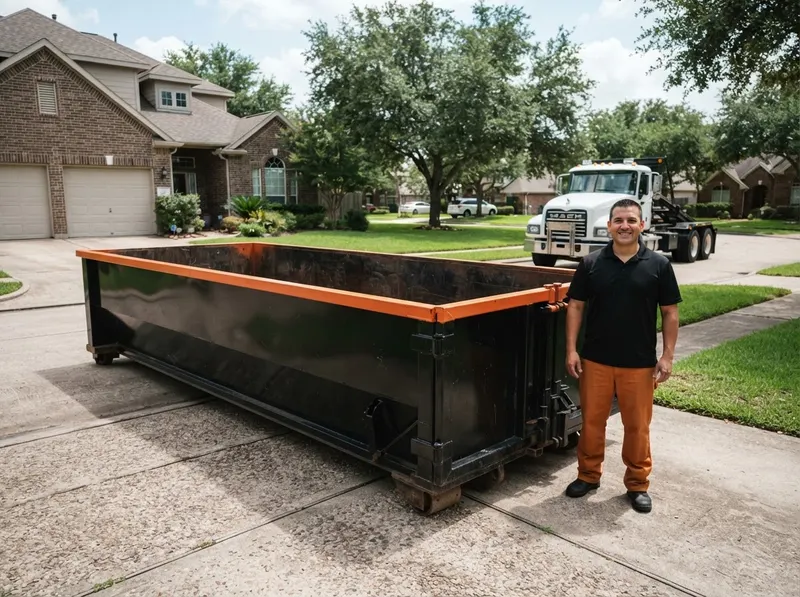
Commercial contractors and residential builders coordinate waste logistics to satisfy local municipal requirements, such as the City of Houston Solid Waste Management Department standards and clean jobsite rules enforced by the Harris County engineering division. When managing tear-offs along residential streets in The Heights or commercial renovations in Montrose, roll-off containers isolate rough materials out of pedestrian rights-of-way. Construction dumpsters provide structural, high-walled containment, operating distinct from loose curbside pickup services because the loading process remains entirely self-directed by on-site trades. Placement on paved driveways in Memorial or River Oaks utilizes structural wood planking under the steel wheels to guard slab integrity against weight transfer stress, adhering to established American Concrete Institute pavement load protocols.
Selecting container dimensions depends on structural material density versus total volume. A 10-yard container at $595 handles dense structural items like bath tile, masonry, and subflooring from remodels in West University Place without violating gross axle limits set by the Texas Department of Public Safety. For extensive framing tear-outs in Oak Forest, whole-home roof replacements in Garden Oaks, or ground-up construction in East End (Second Ward), larger units are necessary. A 30-yard container at $795 accommodates bulky lumber and general jobsite offcuts, whereas a 40-yard container at $895 holds continuous high-volume demo debris from multi-room rebuilds in Meyerland. The mechanical trade-off centers on spatial footprint versus load capacity: a 40-yard box occupies 22 feet of driveway length and features 8-foot side walls that demand loading via the rear swing-and-latch door rather than over-the-side lifting, in alignment with job safety measures outlined by the Occupational Safety and Health Administration.
Placement logistics require specific clearance zones before the roll-off truck arrives on-site. Delivery vehicles operate with single-axle cable hoists requiring 60 feet of straight-line pull-in room and 25 feet of overhead clearance, strictly separated from low-hanging electrical drops, tree canopies, or building overhangs. Unloading alongside active waterways or bayous near Clear Lake requires erosion barriers compliant with the Texas Commission on Environmental Quality to prevent debris migration during Gulf Coast rainstorms. Solid inert waste is transported to permitted regional processing facilities licensed under the Environmental Protection Agency Resource Conservation and Recovery framework. For public street placement where private drives are absent, haulers verify municipal roadway staging permissions through the Houston Permitting Center, while hazardous substances, paints, batteries, and loose chemical solvents must be diverted directly to certified collection centers run by Earth911 programs.
Every job gets a firm, written price after a free on-site visit.
For standards, safe disposal, and service guidance on DUMPSTER in Houston, TX, useful references include U.S. EPA, EPA, EPA, OSHA, Earth911, and Google Maps. General consumer and small-business resources are available from USA.gov, Better Business Bureau, FTC Consumer Advice, U.S. Small Business Administration, and Ready.gov.
Tell us about your construction dumpster job in Houston and we'll send a clear, written quote, usually the same day.
 SummitHaul Container Co.